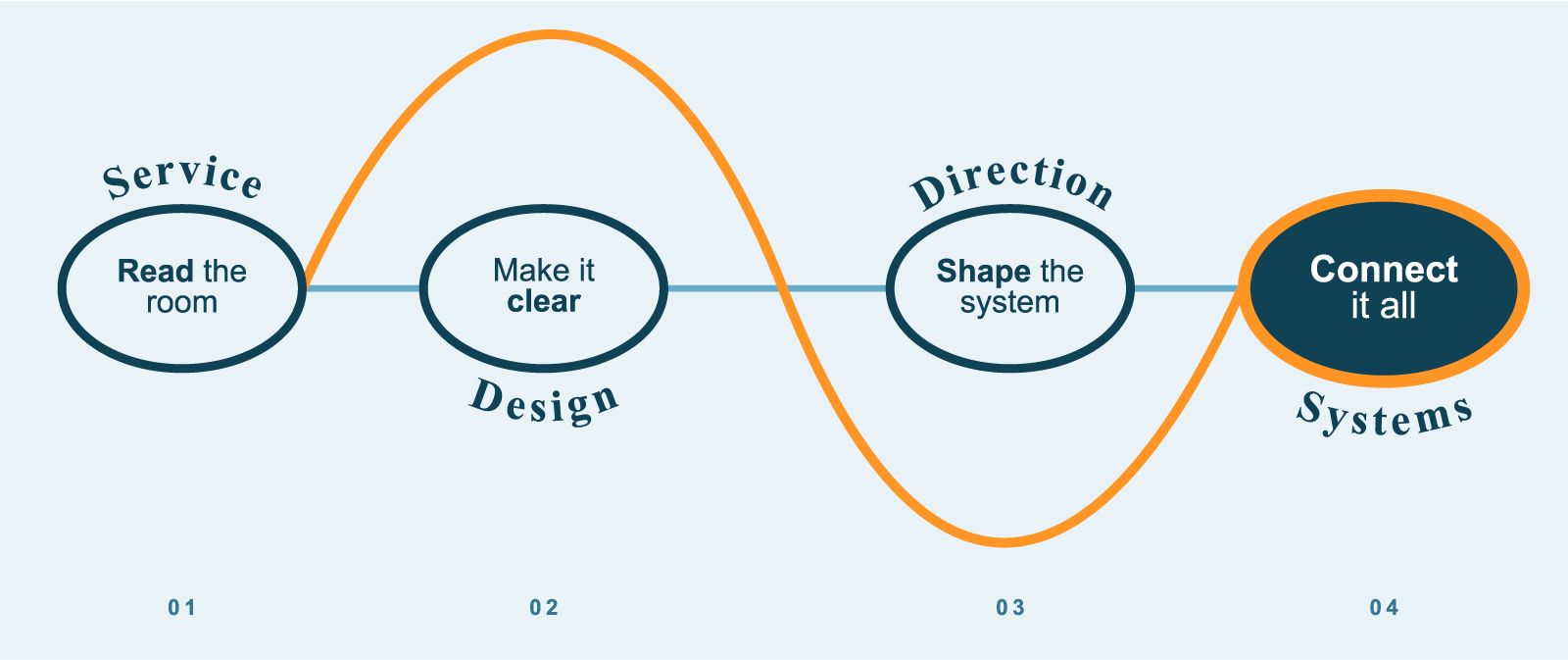
My career began in service work, where I learned to read people and respond quickly. Design taught me how to organize information so others could understand it. Creative leadership expanded my view from individual deliverables to the systems that produce them. Today, I bring those lessons into enterprise technology and focus on what happens where people and systems meet.
A career built in layers
From service to systems
Four professional stages converging into a human-centered systems practice.
Listen
Professional introduction
View the script
My career has never followed a straight line, but it has followed a consistent purpose. I began by learning how to serve people. Design then taught me how to make information clearer. Creative direction taught me to shape the process behind the work. I now bring those experiences into enterprise technology. My goal is to make complex systems work better for the people who depend on them.
Watch
A curious path to a brighter tomorrow.
01
Human-Centered Systems Improvement
I want to deepen my ability to read an organization as a connected system. Before recommending a change, I look for what depends on it and where friction is hiding. I also consider who will feel the downstream effects.
The purpose is not analysis for its own sake. It is to find the change that makes a system easier to use without creating a new problem somewhere else.
Map a workflow as people actually experience it.
Identify upstream dependencies before changes are made.
Explain findings clearly enough to support a decision.
02
Knowledge Governance and Institutional Memory
I want to help organizations keep their knowledge useful over time. A document has little value if no one can find it or tell whether it is still accurate. Important information needs a clear home and someone responsible for maintaining it. It also needs enough context for a future reader to understand why a decision was made.
Make important knowledge easier to find.
Establish ownership and a practical review schedule.
Preserve the reasoning behind significant decisions.
03
Business Analysis and Decision Support
I want to strengthen the connection between a business need and the decision that follows. Good analysis makes the original problem clear before a team commits to a solution. It also exposes assumptions early, when they can still be examined rather than becoming expensive surprises.
My role is to give stakeholders a shared view of the problem and enough reliable information to choose a direction.
Turn ambiguous needs into usable requirements.
Surface assumptions before they become risks.
Connect important decisions to their outcomes.
04
Responsible AI-Enabled Transformation
I want to use artificial intelligence where it can genuinely improve research and documentation. It should support human judgment rather than replace it. Responsible use begins with trustworthy source material and continues through careful review of the result.
I am particularly interested in preparing knowledge systems for reliable AI-assisted retrieval. When the underlying information is governed well, AI can help people reach it faster without weakening accountability.
Test AI applications against a real user need.
Prepare content for more reliable retrieval.
Keep human review and accountability in the workflow.
Where I'm heading
From technical execution to systems strategy.
My long-term goal is to become a trusted systems strategist. I want to enter a complicated environment, understand the relationships shaping it, and explain those relationships clearly enough to guide change.
That path moves me beyond technical execution toward work where analysis influences strategy and the resulting solution succeeds in practice.
Start a conversation
Let's solve something!
If a system is creating more friction than value, tell me about it.
Sources and Media Notes
Written content is based on Charles Rumph's professional history and original career-goal statements. The image and video were created for this portfolio. The audio narration was synthesized from the original introduction script. All media files are stored locally with the website.
List markers use the CSS ::marker pseudo-element, and page layout uses CSS positioning techniques (W3Schools, n.d.-a, n.d.-b).